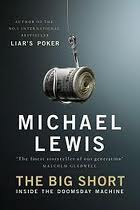
Don't lie to me, you opened this post (or maybe some people didn't even get that far) and were tempted to just keep on walking. I understand. There aren't many people I know in the blogging world that have any desire at all to read about the financial crisis.
But wait! This is written by Michael Lewis, author of "The Blind Side", "Moneyball" and "Liar's Poker". He is proven when it comes to writing a non-fiction book that appeals to all. So don't go anywhere. Read this for entertainment value if you will.
Combine the Michael Lewis effect with the fact that sadly, the financial crisis that brought Wall Street, the US, and ultimately the world to it's knees in 2006 and onward is a tragedy that we cannot ignore. We are still living in the dung pile that was made by investment banks, mortgage lenders, the bond credit ratings agencies, and the government. The effect has been insidious...homes are worth half of what they were five years ago, every neighborhood has a property or two with knee-high weeds in the yard and are in foreclosure, the unemployment is at an all-time high. This was Armageddon like we've not seen since The Great Depression.
I suppressed a groan when I learned we would be reading this book for the Heathrow Literary Society, but at the same time, I felt that to remain ignorant of the facts was irresponsible. This was going to do me good.
I won't bore you with the details...Michael Lewis does a much better job at explanations. He boils it down the best he can, still it is quite complicated. He describes the massive movement to put higher credit risk people in homes, and the creation of the "sub-prime loan" which was always shaky at best. To spread their risk, investment banks creatively compiled these toxic loans into beautifully wrapped packages that were disguised and rated as a good investment, when really it was a house of cards.
What was just pure, good fun in this book were the personal stories. Lewis profiles various characters that worked in the investment markets...a brilliant neurosurgeon with Asperger's who hid in his office and obsessively mastered the markets and the art of investing, an abrasive, wild hedge fund manager whose mouth had no filters, two unpolished college grads who couldn't get a proper job and started investing out of a garage...all of these larger-than-life individuals SAW what was coming. Long before the professionals did. They were like action heroes in this book. I was in awe.
To read about the chain of events that led to Doomsday is baffling. Mind-blowing. It is like the entire world lost their freaking mind. A non-English-speaking migrant worker with an income of $14,000 who bought a house for $724,000. A Vegas stripper who owned five properties. Something for nothing! Free money for everyone! High octane investment bankers who had created a derivative so complicated, few people understood it. But hey, they were making billions of dollars, so what the hell! Live it up, and sell, sell, sell!
At our book club, those who read the book (most that did had backgrounds in finance), there was emotion and anger. It is hard not to be enraged at the lack of consequences for those executives at the top of the food chain. It is hard not to want to move to Bali when you understand how the political goons used Fannie Mae and Freddie Mac to start the whole avalanche in the first place.
But the small attendance at the meeting was telling. Most didn't have the stomach for it. I am the target audience...I am a CPA and my husband is knee-deep in the business. This man I love came home EVERY NIGHT FOR A YEAR AND A HALF raving about this debacle. Reorganizing our debt, moving money around, and damn near burying Mason Jars full of cash in the backyard. I had Wall Street at my dinner table more times than I care to admit. That being said, I had a hard time really grasping the enormity and complexity. After earnestly digging into the book however, I was gripped. I Googled. I watched documentaries. I read articles. I consider myself enlightened and invigorated for having read this book.
Note: I threw my normal review format in the trash for this one. This book was in a league all by itself.
4.5 out of 5 stars
"Cold Sassy Tree" was the March selection for our Heathrow Literary Society. I knew virtually nothing about the story, except that it was a "classic" that was published in 1984 by a journalist who wrote the story while convalescing from lymphoma. I also knew the story had a coming-of-age theme. So I went into this one cold.
Synopsis: Our story takes place in 1906 and is narrated by a 14 year-old boy named Will Tweedy. He and his family live in a small town in Georgia named Cold Sassy, the name derived from the Sassafras trees that grow in that area. Will's grandmother has just died, and his grandfather shocks his family and the gossipy community by marrying a woman 20 years his junior only three weeks after grandma was laid to rest.
And so goes the summer that Will Tweedy will remember for the rest of his life. He experiences life lessons about love, social propriety, and about Jesus. He even gets run over by a train and experiences his first kiss. He learns to drive a car, he ponders death, and finds out that life is neither fair nor ends up happily-ever-after.
My thoughts: When I first started this book, I found it somewhat charming and possibly trying a little too hard to be funny, in a Southern, goofy, teenage boy kind of way. Over time, however, the story became bittersweet and sobering, and I gained a deeper appreciation for the themes that the author threaded through the narrative. I had heard from others that this book was required reading in their high school, and after finishing it, that makes a whole lot of sense. There is a lot to discuss here.
I think one of the most amazing books ever written is "To Kill a Mockingbird". It is innocent, and is about the loss of innocence. It has humor, but is humbling. It teaches lessons about life. In many ways, "Cold Sassy Tree" had similar qualities. Now, don't go looking for the closest piece of rotten fruit that you can throw at me. Nothing will ever match TKAM, but some of the nuances were there, and it made me wonder about Olive Ann Burnes' inspiration.
The prose and dialect was delightfully "Southren". Burns also did an admirable job of channeling a teenage boy (God love her, it must not have been easy), and capturing the personality of a quirky little town at the turn of the century and of the climate of the US at that time. Burns also managed to surprise me with a couple of plot twists that I did not see coming. Overall, I enjoyed the book. I can't say that I loved it and that it warranted five stars, maybe because it felt like it had all been done before, but I would recommend it.
A few words about the audio: The narrator for this audio production was Tom Parker, who is new to me, but appears to have been all over the board in the narration category, including a few classics. It would have been easy to screw this book all to heck, with the tricky dialect, but he did a splendid job. I don't know if he is a Southern boy, but it sure sounded like it.
I do need to point out that dialects can be tricky in print as well. If you struggle with them, audio may be the answer for you. In this case, the dialect seemed organic and very easy to understand.
One pretty huge annoyance was the background noise of the production. There were times that it sounded like Parker was narrating in the corner of a bar at Happy Hour. It was distracting and a disrespect to Parker and Burns' work.
4.5 out of 5 stars
"The Zookeeper's Wife" was a book that was highly-endorsed by a gentleman in our book club and selected for our February read. Really, all I knew was that it was story about WWII, and assumed it was fiction.
After nearly a disc of listening, it dawned on me that this was NOT fiction but a true story! When it comes to WWII, I actually prefer the true stories because there are so many, and they generally are bigger, bolder and more horrendous than anything that can be imagined.
Synopsis: In 1939, when Germany invaded Poland, one of the casualties of the bombing was the Warsaw Zoo. Many of the exhibits were destroyed, along with some of the animals. But the zookeeper and his wife, Jan and Antonina Zabinski, did not abandon it. Instead, they chose to remain there with their young son Ryszard, protecting the remaining animals and collecting a Noah's Ark of wayward creatures, such as lynx cubs, a badger, an Arctic Hare, a pig, and otters.
And hiding and smuggling Jews under the protection of the Underground movement.
A story that is bigger than life, we are told of Jan, who was the mastermind of the dozens of ways Jews could be smuggled out the ghetto, of his determination to fight back, of taking chances. Antonina was the nurturer of all living things, human and animal, and courageous in her own quiet way, maintaining even during the worst times the spirit of merriment for those under her care. Through Antonina's diaries, we experience the day-to-day struggles through her eyes, experience her fears and frustrations.
Setting itself apart from all the other WWII novels, "The Zookeeper's Wife" not only appeals to our yearning for stories of hope and the human spirit, but also includes the role of the animal kingdom into the effort to survive.
My thoughts: If there was ever a book written just for me, this would be it. If I thought I'd heard it all, I was wrong. I was equally enchanted and horrified at how animals...even INSECTS...played a part in the Jewish underground resistance.
The stories about the various ragtag group of animals living with the Zabinski's were adorable...and heartbreaking. I loved hearing about the adventures of the pet pig who liked to play chase, or the Arctic hare that turned carnivore in order to adapt and liked to give kisses. Not all the stories of the animals turned out happy though, and this ripped my heart to pieces. I was truly moved by the idea of man and beast, side by side, doing whatever they must to survive.
The Jews that the Zabinski's aided were also touching. A sculptor, a fox farmer, mothers and children, each with a story and each given a chance at life because of the Zabinski's determination and bravery.
A few words about the audio production: The narrator for this audio was Suzanne Toren. I've not experienced her work before, but she did a good job at managing the German and Polish accents. However, I found her voice to be cold and fairly unemotional, maybe even harsh, which was unfortunate. I believe this book had all the potential to be a five-star read for me, all things considered. Instead, it kept the material at a distance. While I tried to close my eyes and imagine the words without the impact of the voice, I just couldn't do it. I found myself more moved overall by reading summaries and reviews on Amazon. I would definitely recommend reading this one in print.
4 out of 5 stars

Synopsis: Most people are well aware that Frank Lloyd Wright is one of America's great architects. They may have even heard of the man's eccentricities and ego, which are assumed frailties of a creative mind. But what do we know of Mamah Cheney, Wright's lover of a half-dozen years, that was castigated for destroying his first marriage? One part love story, one part historical account of the work of architect Frank Lloyd Wright, and 5 parts study in turn-of-the-century feminism, we are told the story through the voice of Mamah Cheney herself.
At first blush, this could be the stuff of the modern day tabloids: Famous artist and housewife abandon their spouses and children and become lovers. From Mamah's perspective, however, we are exposed to the loveless marriages, a passion that grips the soul so fervently, and the desperate need for female independence, that it is worth, to her, the highest cost.
And a high cost is paid. Not only is Wright's business and Mamah's reputation tarnished, but the media also hounded their crimeless families as well. Throughout the ordeal, though, Mamah remains steadfast in standing up for what she believes, which ultimately is Horan's tip of the hat to all the untold stories of women of this era.
My thoughts: I find that I always truly enjoy stories that are fictional accounts of historical lives, judging by how much I enjoyed "The Lost Summer of Louisa May Alcott" or "Clara & Mr. Tiffany". These real personalities come to life for me, and it inspires in me an obsessive need to know more. My downfall is that perhaps I trust too much in the author's imagination - it is easy for me to get sucked into the drama. I always assume that there are enough solid facts peppered in there to make it a fairly legitimate account of what really happened.
So how factual is this story, really? That was the first question I asked at the end (which by the way, totally pulled the rug out from under me...what the hell?). According to articles I have read, it took Horan seven years to write this book because of all the research involved. Horan tediously tracked down correspondence, newspaper clippings, memoirs of friends and neighbors, vigilantly confining her novel within the boundaries of the facts. Therefore, disciples of Wright may go into the book knowing how it all turns out - it is a matter of record. I did not, and it knocked the wind out of me. Use that information how you will.
I was mesmerized by the spirit of Mamah and her need to be her own woman. I was mesmerized by her refusal to kowtow to the great Frank Lloyd Wright when he negligently left his bills unpaid or belittled a friend. I was mesmerized by the setting of the US and Europe in the early 1900's. Horan's words made it all come alive. Equally, I was horrified as a mother that both of these individuals would disregard their children for the sake of an affair. I realize it is what it is, but it doesn't mean I have to like it. You'd think, then, that I would have hated Wright and Mamah, but I didn't. I found them refreshingly human.
Separating the shocking true story (and its devastating effect on me) from the writing, however, I would highly recommend this book. It is a piece of feminist and architectural history that is worthy of your time.
A word about the audio production: With the exception of frustrating uploading issues (the online database did not recognize any of the 100 tracks on any of the 12 CDs), this was an excellent audio. The narrator, Joyce Bean, projected the sophistication and assurance and pain that was Mamah. While I've never listened to Joyce, she and I have been ships passing in the night it seems, because she has narrated works of Lisa Jackson, Kay Hooper, Karin Slaughter, Tami Hoag and Sandra Brown, all authors I have read. She has a smooth, pleasant voice and I'd be thrilled to listen to her again.
4 out of 5 stars


Synopsis: The setting is Salinas Valley in Northern California, turn of the century, when farmers are scratching out a living, and capitalism is on the rise. It is against this backdrop that the epic story of good versus evil is told. At the heart of the story is two half-brothers, Charles and Adam, one loved more than the other by their single father, and thus plants the seed of jealousy and competition that will endure into the next generation.
Enter the perfect antagonist, Cathy, who believes the world is all evil, and sets out to use that to her advantage with a heart as cold as ice, for personal gain. Not only will she infect the lives of Charles and Adam, but have a pervasive influence on the lives of her and Adam's twin sons Cal and Aron.
Rounding out one of the most realized cast of characters in a literary novel are the supporting crew that deserve their own separate billing...Samuel Hamilton, the joyous, Irish farmer full of friendship and sage advice for his neighbors, and Lee, the Chinese American that works for Adam Trask and serves as the caretaker of Cal and Aron's souls.
In what has been heralded as the "great American novel", the reader finds themselves overwhelmed in themes of good versus evil, jealousy, brotherly love and hate, and the notion of "timshel" or "thou mayest"...freewill to overcome that darkness which can ruin a man.
My thoughts: To even attempt to write a synopsis on this monster is bogus, plus 90% of the reading world already knows the plot anyway, but I had to try for sport. This is the perfect example of a novel being greater than the sum of its parts. It is big and epic, filled with four dimensional characters (where they almost stick their fingers out of the pages and poke you in the eye, or the ear as it were), and expansive themes that my little brain almost can't comprehend.
The emotions laid before you are jarring. There was very little here that was lukewarm. I hated Cathy - she was as close to pure evil as you find in a book, and made my skin crawl and my stomach turn. But I loved to hate her too! I wanted to hug Samuel Hamilton and Lee, and befriend their warm, giving hearts. I wanted to smack Adam, that sap. For all the mistakes his father made, he turned around and made the same stupid mistakes with his own sons. He was gullible as well. Grrrr. Then there was all that murky, oily, gut-deep turmoil between brothers. It was expressed in such raw and feral terms, and at such a Cain and Able level of human nature, it made me uncomfortable and squrim in my chair.
It was these violent emotions that Steinbeck so perceptively described that caused me to spiral into a malaise when I finished the audio. The anger! The angst! The tragedies! The moral ruin! While the book was brilliant, it was not uplifting. Not even Samuel Hamilton, Lee, and the ultimate victory of timshel could save me. I wildly grasped for a David Sedaris audio afterwards like a life preserver.
A word about the audio production: More than a few of my book club members raised their eyebrows when I mentioned I would be "reading" this classic on audio. Almost seems sacrilegious, doesn't it? But it did work. At the outset, the narrator, Richard Poe, came across as stiff and vocally inflexible. But as the story developed, he grew on me. For anyone that may not have the time to sit and read over 600 pages in print, I'd highly recommend the audio option.
5 out of 5 stars

![]()
So probably 80% of the reading world already knows this. The joke was on me. This amazing journey into Ethiopia's history, into twin-ness, into the human side of medicine, will most definitely be among my "best of" lists at the end of the year.
Synopsis: The lives of Sister Marie Joseph Praise, a devout missionary nun, and Thomas Stone, a quirky but enigmatic young doctor, intersect at Missing Hospital in a poor town in Ethiopia. Their destinies intertwined, they form a deep bond through the rigors of surgery as doctor and assistant. To everyone's surprise, one day Sister Praise goes into labor, and dies giving birth to conjoined twins, Marion and Shiva. Stone panics and disappears, leaving the boys effectively orphaned. Their stories are told in first person by Marion.
Two Indian doctors at Missing decide to marry and raise the boys as their own. Spanning decades, we witness Ethiopia's tumultuous history, the havoc it wreaks on the boys' lives, the medical challenges in a poor, third-world country, the notion of being predestined for a life in medicine, and the loving and sometimes violent community in which the boys are raised.
"A childhood in Missing imparted lessons about resilience, about fortitude, and about the fragility of life. I knew better than most children how little separated the world of health from that of disease, living flesh from the icy touch of the dead, the solid ground from treacherous bog."
When adolescent emotions cause a division between the twins, it is only when Marion becomes a surgeon himself and moves to New York that the strength of the boys' bonds are truly tested.
"Only the telling can heal the rift that separates my brother and me. Yes, I have infinite faith in the craft of surgery, but no surgeon can heal the kind of wound that divides two brothers. Where silk and steel fail, story must succeed."
My thoughts: With grace and restrained passion, Verghese has created an epic story that very quickly swept me off my feet. Because of the first-person narrative from Marion, it immediately felt personal and intimate. Marion was a young man with heart and compassion, who admitted to his own inadequacies and fears, and it was impossible for me not to love him and everyone whom he loved in turn. The characterization, through Marion's eyes, was brilliant.
Knowing that Verghese was an accomplished physician himself, I went into the experience worrying that the prose might be too technical or too rigid. Instead, it was beautiful and refined, at times even breath-taking. (I know that sounds a little over-dramatic but it was.) Verghese used his medical knowledge to lend an air of authenticity to the dialogue, but never did it alienate me or make me feel lost or stupid. I really have never had an interest in cutting people open and repairing an intestine or transplanting a liver, but in this story I lived the miracle of saving lives, of attending the sick by listening and caring, and made a tiny part of me wish I could try.
Without being too mushy (no Disney endings here), this book had one of the biggest hearts you could find in modern fiction. A heart full of compassion, forgiveness, commitment, human spirit and love for mankind.
Reactions from the Heathrow Literary Society: Unanimously my book club loved this book with all of their being. One member called it a "masterpiece". Another, an accomplished reader, called it a book that would be in his top ten of all time. This type of reaction rarely happens (only once with "The Book Thief") and is a testament to the universality of this beautiful novel.
5 out of 5 stars
![]()

It would be nearly impossible not to fall in love with this guy. He is approachable and friendly, with his southern accent and easy charm. He is laid back (which we tested by having some technical difficulties with the phone and the speakers). And most of all, humble. He claims that alot of what he has written has been "horrible", only brought to a level of genius through his wife's editing. He despises the sound of his voice on interviews (and was cringing from the echo that he heard coming out of our speakers). Falling into my role of Southern Belle, I'd say "bless his heart".
On the development of Crooked Letter's plot: Early in his career, he had the general idea of a book about brothers. He noodled it around, decided that maybe it should include a small-town police officer. Years pass, and an African-American friend suggested that the police officer should be black. As Franklin admitted, he wouldn't dare presume to be able to understand someone from a different race (sometimes not even someone white or male), but this suggestion from his friend gave him permission. His friend's feedback further into the development of the book was priceless.
Only when his wife (a poet) won a Fulbright Scholarship and the family moved to Brazil for a time, did the book develop in earnest. Franklin said he had time on his hands, and he put his full effort into the book.
On his development of the character Larry Ott: Because most of Crooked Letter was written in Brazil, he had to draw his details and experiences from pure memory. Therefore, the mechanic father, the drive-in theater date, the mask, picking up a black mother and child walking along the road on a cold day, the obsession with all things Stephen King, all shards of Larry's life...were all drawn from Tom's life.
Did someone mention Uncle Stevie? No quicker way into my heart, as you all probably know. Tom grew up on Stephen King, and learned alot from his genius. (His favorite book is The Dead Zone.) He also much enjoyed Joe Hill's (Stevie's son) "Heart-Shaped Box", and has "Horns" on his TBR stack. So far Uncle Stevie has not indicated that he is aware of Franklin's fandom and many mentions in Crooked Letter, but maybe that will come when the movie is made.
Huh? Movie? Yes, well, it has been optioned! Only time will tell if that translates into something tangible. Franklin thinks (and we concurred) that Billy Bob Thornton should get dibs on Larry. And well, who else but Denzel should play Silas?
On the discussion-worthy ending: (Relatively spoiler-free) There were several people within our book club that were less than thrilled with the ending...they preferred things be wrapped up a little neater than they were. Others described the ending as magnificent and the most beautiful part of the book. Tom admitted to really struggling with it. One ending was very "Kumbaya" with singing and crying and hugging. His wife deemed it horrible and recommended a re-write. He messed with the dialogue between Silas and Larry at the hospital. Nothing worked. At the end of the day, he decided "less is more".
But what about the murders? (Warning! Minor spoilers ahoy!) The heart and soul of this book is about the relationship between Larry and Silas. The various murders were really just window-dressing. The best justification of this was when Tom admitted that late in the development of the book, he realized he had to address the issue of the murder of the modern-day girl. Who had killed her? Under what circumstances? One idea that Tom played with (something he has not told many people, so you heard it here!) was making the murderer (for those who have read the book, you know who I'm talking about) Larry's alter-ego. The Heathrow Literary Society gasped in unison. But no, that has been done before ad nauseum. He wouldn't go there. And we were glad.
Relatively unknown but amazing Southern novels: Music of the Swamp by Lewis Nordan. Mrs. Bridge by Evan S. Connell. And anything by William Gay (whose inspiration was Cormac McCarthy).
On audio books: (You knew I'd ask, right?) Sadly, Tom said he had nothing to do with the production of the audio book. I assured him that the narrator, Kevin Kennerly, did a fabulous job. I find this a particularly scary idea, though. Bad narrators can KILL a book, and there are alot of audiophiles out there. I would want right of refusal.
What's next? A new baby has slowed things down in the writing department, but Tom and his wife are working on a project together, with hopes of seeing it on the shelves in the not-too-distant future.
After we hung up with Tom, we all were bubbling over with love for Tom. We all agreed that he is a guy we would love to sit down and have a glass of wine and dinner with (in comparison to Franzen, who 95% of us wouldn't give the time). He entertained us, made us laugh, and inspired us to do some serious work on his back list...

 The first four selections for our Heathrow Literary Society were haphazard selections that the group voted on as being interesting. After that, we decided to try to make more deliberate choices spanning various genres...classics, memoirs, thrillers, etc. "Appointment in Samarra" was our attempt at a classic, unknown to all of us but our leader, who read it in a previous book club. We were all game, primarily because we'd been reading chunksters and this little guy was only 270 pages long.
Published in 1934, this was O' Hara's first novel. It has been included in various "Top 100 books lists" over the years, and O' Hara has been described as everything from "the real F. Scott Fitzgerald" to "a well-known lout".
The title of the book requires a little explanation, as it is never actually mentioned within the story. "Appointment in Samarra" is a reference to W. Somerset Maugham's retelling of an old story (from Wikipedia):
A merchant in Baghdad sends his servant to the marketplace for provisions. Shortly, the servant comes home white and trembling and tells him that in the marketplace he was jostled by a woman, whom he recognized as Death, and she made a threatening gesture. Borrowing the merchant's horse, he flees at top speed to Samarra, a distance of about 75 miles (125 km), where he believes Death will not find him. The merchant then goes to the marketplace and finds Death, and asks why she made the threatening gesture. She replies, "That was not a threatening gesture, it was only a start of surprise. I was astonished to see him in Baghdad, for I had an appointment with him tonight in Samarra."
Or, in other words, Death is going to find you, it's inevitable. A little foreshadowing action, then?
Synopsis: So in this case, whose death is inevitable? Within a handful of pages, we know that would be Julian English, a member of the upper middle class in Gibbsville, Pennsylvania in the 1930's. This society consists of decadent country clubbers who attend multiple parties and dances a week, who drink heavily, who come from some type of money, and who are quietly but threateningly governed by a local mobster.
Julian is the only child of a local doctor, now runs his own Cadillac dealership, and is married to the lovely Caroline, who has yet to conceive a child. Julian is a self-absorbed chap who thinks that the world revolves around him, and fancies himself the life and light of his social circle. One night, in a drunken fit of annoyance, Julian throws his drink in the face of a man who is a pillar in the financial and Catholic community. Thus begins Julian's three day spiral into utter ruin, making one bad decision after another, committing impulsive, embarrassing public acts, and ultimately keeping that appointment in Samarra.
My thoughts: O' Hara boldly depicts social status, class conflict, sexuality, and small-town politics in a way that must have shocking in his day. In many ways, it reminded me of "Peyton Place" (written in 1956), with its scandal, tragedy, class issues and quirky characters. I was impressed with "Peyton Place" for its decent writing, despite its reputation for being a trash novel. My expectation of "Samarra" was that of a classic piece of literature, worthy of book club discussion, but to me was underwhelming.
I suppose I never really felt invested in any of the characters. Julian was completely obnoxious...a spoiled brat who had no self-control and overreacted when things don't go his way. All of his problems could have been resolved, but I doubt he'd ever encountered such conflict and chose instead to avoid it by committing suicide. And I'm thinking that was the intended image the author wanted to portray. The supporting characters were entertaining, but lacked depth and seemed only to stand as symbols for society at the time.
In doing some research in an attempt to better "get" the story, I read that O' Hara was known for being quite adept at literary dialogue, which caused me to do a double-take. In fact, the dialogue was one facet of the prose that really bothered me. It felt stilted, uncomfortable and false, and even between a man and wife in the heat of an argument, way too sharp and cold and unemotional. Not very realistic, in my opinion. Was this intentional as well?
Lastly, and most importantly I think, is my opinion that O' Hara mistitled his book. By using the title "Appointment in Samarra", the implication is that Julian has a predetermined date with Death. In reading the story, this is far from the truth though. Death was not inevitable here, and could have been avoided if Julian hadn't been so dense. Hell, the guy that got a drink in his face actually LIKED Julian, and sent flowers to his funeral. Is there something I'm not getting?
My takeaway from this heralded wonder of a literary work is confusion, feeling like I'm not understanding a point, and general apathy. I don't feel like it was a waste of my time, yet I was not moved either.
Viewpoints of the Heathrow Literary Society: The book was received well overall. Most people agreed it was dark, and wasn't their favorite book, but enjoyed watching the hot mess Julian created for himself. Myself excluded, there was appreciation for the tight plot, the characterization, and the unique view of society during this era. One gentleman did come forward and state that he did not like the book, period. I believe my opinions were closer to his than the rest of the group.
In fact, most of the group thought the title of the book was completely appropriate...that Julian was headed for his date with death from the very beginning. I respectively (but emphatically) disagreed. There was some consent at the end of the meeting that perhaps O' Hara might be better suited to short stories (which he is known for) than a full length novel. The book, for its pros and cons, did inspire great discussion and differing opinions, which is our ultimate goal.
3 out of 5 stars

 OK, I am finally biting the bullet. I am FORCING myself to sit down and write something about this book. Because sometimes books are too big for words. They cover too much territory, too much human emotion, too much ugliness, too many messages, to really get the point across.
Years ago, I read The Corrections. A friend loaned it to me, stating that he "couldn't get through it, so good luck". Just to prove my super-woman tenacity, I slogged through it. I hated it. The characters were miserable and obnoxious. Then I finished it. Then I decided I really did like it.
So when Freedom was released, I was mildly interested. But it was long, and Oprah endorsed it, everybody and their brother was talking about it, and when my book club discussed reading it, I voted NO. I can be bitchy that way. But then there was a mix-up, and somehow it was published in our country club newsletter that we were reading Freedom for February, and our hand was forced. Now my dander was really up. OK FINE! IF I HAVE TO! I embarked on 19 discs of audio.
Synopsis: At the heart of the novel is the seemingly All-American Berglund family...Walter and Patty, and their two kids Joey and Jessica, living in a big house in St. Paul MN. Walter is the do-gooder, environmental-loving lawyer, Patty the pretty, athletic stay-at-home mom, with two perfect over-achieving children. At the beginning of the story, we get an outsider's perspective of the family from a few jealous neighbors' narratives, then we dive in - hold your breath! It's deep and murky! Walter, Patty and Joey (and a few other main characters) all take turns narrating personal thoughts and events in their past, what made them the people they are, and the nitty gritty of what is really happening in their twisted, miserable lives. Drugs and alcohol abuse, manipulation, adultery, kinky sex, lying, cheating, stealing, rape, and any other type of depravity you can think of. What this all amounts to is a thorough character study on each narrator, from childhood on. So thorough, you know it like your own story after it is all over and done with. And what we learn isn't necessarily likable, but human and real and exposed.
But there is so much more than "just" family dysfunction (that is a real big fat juicy "just"). Big issues such as over-population and the pressure on finite resources, raping our natural environment for political gain, the ethical dilemmas of capitalism in Iraq, and the rapid-fire information overload and instantaneous gratification that our culture has become. For a side tour, Franzen delves into the business of rock 'n roll, and liberally peppers his prose with lots of pop culture, showing us he is hip to Bright Eyes and Donnie Darko. It seems that Franzen has alot on his mind, and he has thrown it all at us. Whether it was intended to hit us in the head and incite an epiphany, or simply draw blood, I'm not sure.
My thoughts: Most of humanity fell in love with this book, but I was not one of them. I was highly entertained, in a way that it is entertaining to watch the freakshows that go on Doctor Phil and have their frailties laid out for all to see. The characters in this book are not caricatures. They feel as real as you or I. But they are damaged, unhappy people, angry at each other, life and society in general. Franzen's prose also comes across as sarcastic and generally negative. Then there is all that sex, which I thought added nothing but a layer of skeez. As easy as it was to listen to all of this, I often felt like I needed to take a shower (no, I didn't need a cold shower, I just needed to rid myself of the mental slime).
But then, after 18 discs of rolling around in the muck, getting it in my ears and eyes and mouth, it was like the whole book took a Prozac, and for the last disc, the plot gently floated in a dreamy fog off stage left. OK, well, that is nice. But it was a confusing shift in mood, and it left me unsettled. You mean they didn't all self-destruct in the end? I kinda wanted to see them all locked up in a room together to see who would come out alive.
As grumpy as this all sounds, I tip my hat to Franzen and all of his cleverness. The theme of "freedom" is deftly woven into every nook and cranny. Whether it is freedom from the confines of marriage and kids, freedom of expression, freedom from parental control, or freedom of songbirds to exist without the fear of being eaten by kitty cats. In the search for the ever-alluring freedom, however, the characters find that perhaps it isn't all its cracked up to be, or even that its existence is just an illusion.
As brilliant as Franzen may be, however, I thought it was a shame he wasted it on such misery. I likened it to Picasso drawing cheesy charicatures at a street fair, or painting women's boobs at a strip club.
A word about the audio production: Whatever my gripes for the book, the narrator, David LeDoux, was spectacular. David is a new-to-me voice, but in a quick glance, I see he has also narrated "Water For Elephants" by Sarah Gruen and "Shiver" by Maggie Stiefvater, just to name a couple. His voice was authentic and unforced, and captured nuances of the various personalities of the characters perfectly. This is a narrator I'd listen to again without hesitation.
Opinions from the Heathrow Literary Society: We had eleven member attend this meeting, and two people admitted to liking it. One member said she liked it fine until she saw interviews with Franzen, and then was turned off. One member said there was nothing redeeming in this book whatsoever, and her husband, who had to endure the audiobook with her on a trip, thought she was insane for finishing it. The rest of us didn't feel it was worth the effort, and would not recommend the book. We decided that Franzen is probably not a very happy person. On the bright side, it was probably the liviest discussions yet.
3 out of 5 stars

 There aren't many people tromping around these days that haven't at least HEARD of "Water for Elephants", Gruen's claim to fame. Maybe they've read the book or they are going to see the upcoming movie, or friends have been raving about it. Here lies the danger, however, for anything that the author writes from here on forward. There is a taste of success, there is pressure for more, and then things fall apart. Which is what seemed to happen in this case.
Synopsis: Our dual storyline starts off merged: The beautiful Isabel, a scientist at a Great Ape Language Lab, is showing off her eerily human, highly intelligent test subjects to reporter John Thigpen, who is enchanted by the experience. Thigpen goes back home to Philly, and that same day the Lab is bombed presumably by terroristic animal rights activists, seriously injuring Isabel and releasing the apes. Bad guys purchase the apes for nefarious purposes, which becomes evident through a public display of very bad taste.
Then our storylines separate for a bit. Thigpen's wife, an unsuccessful author, wants to try to her hand at writing a comedic series in Hollywood. Thigpen is miserable at his job as a newspaper reporter, particularly when an ambitious colleague "steals" his story on the apes. So they move to Los Angeles, Thigpen hires on at a tabloid, and chases down the ape story for himself.
Isabel goes through various stages of recuperation and depression. She breaks up with her slimy two-timing fiance. She longs to be with her apes. She finds out where they are and attempts to make contact.
Then things get...weird. Russian hookers. Exploding meth labs. A porn king. A homeless, farting pit bull. A paternity scare. And then a fairly predictable ending, all perfect and shiny and wrapped up with a big red bow.
My thoughts: I usually try to keep my synopsis fairly neutral but I failed this time. This whole thing went wrong in so many ways. The bad guys were caricatures, with crooked smiles and cold eyes and sinister statements. The plot wandered. Maybe the ape thing wasn't exciting or Hollywood enough, so Gruen had to throw in random action? It was like a twisted Disney movie.
There was a decent amount of seemingly factual information about the Bonobo Apes...their behavior, their ability to communicate through sign language, their higher intelligence. This was pretty fascinating stuff, although I kept asking myself silently "Is this realistic? Do Bonobos really act like this, with this much reason and emotion?". I never dug around on the Internet to obtain an answer to that question. I have to assume that Gruen did her homework. I guess my point is that the behavior of the apes in the book was just edgy enough that I wasted mental effort in wondering if it was truth or exaggeration.
If I hadn't been reading this book for my book club, I would have dropped this one like a hot potato.
A word about the audio production: The narrator for this production was Paul Boehmer, someone who appears to have been around the audiobook block, as well as a minor actor. Personally, however, I found him smarmy and a little too feminine-sounding and he made my skin crawl. I would not choose to listen to him again. I think it is important to note that this did not have any influence over my opinion of the book and its plot. The entire package did not meet my expectations.
Thoughts from the Heathrow Literary Society: This month at book club, it was my turn to facilitate the discussion, and I was worried that my 'tude would be evident. So I just kept quiet and let the people speak. I heard words like "superficial" and "weird" and "I'm indifferent". One member read the book a couple of months ago, and couldn't recall the name of a single character, and had forgotten about the Russian prostitutes. We all agreed the ape angle was interesting, but not enough to squeeze out more than a 2.5 or a 3 out of 5 stars from anyone at the table.
2 out of 5 stars

 Some books are beyond description. I finished The Book Thief over a week ago, letting the plot, the words and the preciousness of the book sink in and plant seeds in my brain. I discussed it at our Heathrow Literary Society, thinking that might help solidify my thoughts. Nada. So I'm just jumping in and hoping that if you are one of the few that haven't read this masterpiece, I will convince you to read it before I'm through.
Synopsis: Liesel Meminger, a nine-year old girl in Nazi Germany, is in transit with her mother and brother to be dropped off with foster parents who can better care for her and her brother. Along the way, her brother dies, and at his gravesite, Liesel finds a book in the snow and takes it. Never mind that she cannot read. She innately understands the power of the written word, and thus begins her life as a book thief.
Liesel's story is narrated by Death. Death, while extremely busy at this time in history, has noticed Liesel to be a very special child. She goes to live with her new Mama, a loud belligerent frau, and Papa, a gentle man who teaches Liesel to read every night after Liesel awakes from nightmares. Liesel is embraced by the quirky, endearing villagers, each of them a character larger than life. But WWII isn't just a war that affects just Jews. It takes its toll on hard-working, God-fearing Germans like Liesel's new community. To combat the horrors of the war, Liesel continues to seek out "free" literature...from a pile of burning books, from the Mayor's library. Words, in the right hands, have tremendous power, and ultimately save her life.
Death also gives us a peek inside his daily routine, which isn't pleasant. Death is not the grim reaper, however, waiting anxiously to grab souls from dying bodies. He is distressed by all the carnage of the war, is over-worked and doesn't make the decisions, but a job is a job. The worst for Death is the children, but he assures us that he gently carries each child's soul in his arms with care.
My thoughts: Oofah. Where to begin? As most of you are aware, I have a "thing" for WWII novels. I've read many of them, from all perspectives, all nationalities, non-fiction and fiction. This particular portrayal, however, is perfect in every way, if you would forgive me for calling anything in this era "perfect". It is innocent, it is dear, it is humorous, it is heartbreaking.
The characterization is absolutely amazing. Everyone in the story, from Liesel and her foster parents, to the Mayor's shell-shocked wife who "allows" Liesel to steal her books, to Liesel's impish friend Rudy who dreams of stealing a kiss, to Max the Jew hidden in Liesel's basement, to the hoodlum fruit stealers...these are characters that are so real you can close your eyes and conjure them. In your heart, you know them and you love them. Halfway through the book, I said to myself "it is WWII, and I know someone is going to die, and I can't stand the thought of losing a single one of them". So I was falling apart (and laughing at all of their antics at the same time) for most of the story.
The prose is so very clever and beautifully simple. Using Death as a narrator is clever. Death is really a likable and conversational fellow, which keeps the tone from becoming too heavy most of the time. He leads into each section of the book with an outline of what is to come, which acts as a teaser. He offers side notes, definitions and commentary to certain events that occur. If his presence wasn't so ominous, you wouldn't mind having him around more often. In fact, it is easy to imagine that when your time comes, it wouldn't be so bad if he were there to help you on your way.
I think it is important to note that this book has been marketed as Young Adult book. I think it is fair to say that this book would be appropriate for teens, but is more beautifully written than most books for adults. It is proof positive that YA books can be exquisite and complex, and need not talk down to its audience.
A word about the audio production: I'd never listened to the narrator Allan Corduner before. He seems to be a reader of YA, notably Inkdeath by Cornelia Funke and Magyk by Angie Sage. But bravo on whoever found this man, because he was delightful to hear, and perfect for the role. Fans of the audiobook will be thrilled with the experience.
Thoughts from the Heathrow Literary Society: All of the members present, save one that didn't finish the book and seemed to have an issue with WWII in general, were deeply touched. They were charmed by Liesel, Mama and Papa, Rudy, and even Death. One of the members called it "a keeper". I sat back and watched my friends with earnest, animated faces talk about this amazing read. It made me feel all warm and fuzzy inside.
Bottom line: One of my best books of 2010. Don't let the topic scare you. This is a must-read.
5 out of 5 stars

 Somewhere in the back of my mind, I think I recall that John Irving may have been the original inspiration of Rebecca's term "pantyworthy". (Meaning the author is at such a rock-star status, that bibliophiles could be inspired to throw undergarments at them.) Whether this is true or not doesn't matter...it is what I think of when I hear the man's name. Yes, the man is attractive, and yes he is a storyteller. I was quite open to the idea of Irving's latest, Last Night in Twisted River, being our first official read for the Heathrow Literary Society. I needed to get in on the excitement.
Synopsis: Widower Dominic Baciagalupo, a cook for a small logging community in New Hampshire, and his son Daniel live a modest but comfortable existence until two tragic events change the course of the rest of their lives. Dominic decides that to best protect his son, they must flee, and do so for a majority of their lives.
Covering 40+ years and thousands of miles (including Boston, Iowa, Colorado and Canada), Irving delivers with vivid description the lives of Dominic and Daniel and their odyssey. The rugged logging lifestyle, the drug culture and Vietnam, the passion of en familia Italia in Boston, a street-level view of the restaurant business, the life of a successful author, child-rearing in an all-male single-parent household, US politics after 9/11, and probably a dozen more storylines I'm not remembering.
There is more here, though, than a slice of the 20th century pie. It is also about the softer stuff...manhood, friendship, loneliness, loyalty, pride, and love. Perhaps for Irving, this is his all-American novel?
My thoughts: This is one of those books that you must go along for the ride. To enjoy the ride, you're going to have to come to terms with total cohabitation with the Baciagalupos for as long as it takes you to read 574 pages (or 20 discs). There is alot of detail to wade through here.
Overall, I found the story mildly entertaining. Intriguing at times, slow at others. I thoroughly enjoyed shadowing Dominic in his life as a cook. His famous pizza, his pasta dishes, his dabbling in French and Chinese cuisine...I felt my inner foodie purring at the description of Dominic's creations. I would also presume most of you would find the development and nurturing of Daniel's career as a successful novelist to be of interest as well. The writing process, the joy and angst of having books adapted into movies, and the incorporation of an author's personal experiences into his books is something that obviously came directly from Irving's heart.
The character of Ketchum, Dominic and Daniel's life-long friend, confidant and protector, captured my heart. In fact, only towards the end did I realize that Ketchum was as much of a main protagonist as the Baciagalupos, and was the underlying soul to Irving's tale.
I had some numerous gripes as well, some minor and some major. Irving tended to repeat Dominic and Daniel's names, their full Christian names with all aliases, all the time. I wasn't sure what his point was, but it bothered me. There was also a significant amount of jumping back and forth in time, and back and forth between characters. This was extremely distracting until about 2/3 of the way through the book, when I began to notice that there was a pattern. The pattern having elements of teasing and a building of tension from time period to time period.
I also felt that the ending was contrived. I'm skirting around the details of this one because of spoilers, but Daniel's big moment at the end of the book, his big epiphany if you will, fell flat for me. It seemed that Irving reached into the grab bag of plotlines contained within the story, and plunked it down as The Answer To Happiness. I didn't buy it.
A word about the audio production: Funny thing about Arthur Morey, the narrator for Last Night in Twisted River. This is the second audio I've listened to with Morey at the microphone (first was Homer and Langely). With both books, I initially was bored with his voice...it just kind of echoed inside my brain and sounded like the teacher in Peanuts (wwwaaaah, wa wwwwah, wa wwwwah). But in both instances, he grew on me and ultimately was very comfortable with the listening experience. He's not my favorite narrator, but I'd happily listen to him again.
Thoughts from the Heathrow Literary Society: We had a most excellent discussion in our newly-formed book club. We have a wonderful mixture of old and young, chick-lit readers and some of the most well-read people I've ever met. The discussion was lively and insightful. Overall, nobody loved this book. For admirers of Irving (one man had read EVERYTHING Irving had written), this was not a good representative of Irving brilliance. It was noted that the elements present in Twisted River were the same elements that had been included in other Irving novels as well, and this was just a compilation. They had been there, done that. We all agreed the only reason this book would ever be read was because it had been written by Irving.
3 out of 5 stars


 Posts
Posts