
Showing posts with label Audio. Show all posts

Thursday, December 23, 2010

The Book Thief - Markus Zusak (Audio)


Some books are beyond description. I finished The Book Thief over a week ago, letting the plot, the words and the preciousness of the book sink in and plant seeds in my brain. I discussed it at our Heathrow Literary Society, thinking that might help solidify my thoughts. Nada. So I'm just jumping in and hoping that if you are one of the few that haven't read this masterpiece, I will convince you to read it before I'm through.

Synopsis: Liesel Meminger, a nine-year old girl in Nazi Germany, is in transit with her mother and brother to be dropped off with foster parents who can better care for her and her brother. Along the way, her brother dies, and at his gravesite, Liesel finds a book in the snow and takes it. Never mind that she cannot read. She innately understands the power of the written word, and thus begins her life as a book thief.

Liesel's story is narrated by Death. Death, while extremely busy at this time in history, has noticed Liesel to be a very special child. She goes to live with her new Mama, a loud belligerent frau, and Papa, a gentle man who teaches Liesel to read every night after Liesel awakes from nightmares. Liesel is embraced by the quirky, endearing villagers, each of them a character larger than life. But WWII isn't just a war that affects just Jews. It takes its toll on hard-working, God-fearing Germans like Liesel's new community. To combat the horrors of the war, Liesel continues to seek out "free" literature...from a pile of burning books, from the Mayor's library. Words, in the right hands, have tremendous power, and ultimately save her life.

Death also gives us a peek inside his daily routine, which isn't pleasant. Death is not the grim reaper, however, waiting anxiously to grab souls from dying bodies. He is distressed by all the carnage of the war, is over-worked and doesn't make the decisions, but a job is a job. The worst for Death is the children, but he assures us that he gently carries each child's soul in his arms with care.

My thoughts: Oofah. Where to begin? As most of you are aware, I have a "thing" for WWII novels. I've read many of them, from all perspectives, all nationalities, non-fiction and fiction. This particular portrayal, however, is perfect in every way, if you would forgive me for calling anything in this era "perfect". It is innocent, it is dear, it is humorous, it is heartbreaking.

The characterization is absolutely amazing. Everyone in the story, from Liesel and her foster parents, to the Mayor's shell-shocked wife who "allows" Liesel to steal her books, to Liesel's impish friend Rudy who dreams of stealing a kiss, to Max the Jew hidden in Liesel's basement, to the hoodlum fruit stealers...these are characters that are so real you can close your eyes and conjure them. In your heart, you know them and you love them. Halfway through the book, I said to myself "it is WWII, and I know someone is going to die, and I can't stand the thought of losing a single one of them". So I was falling apart (and laughing at all of their antics at the same time) for most of the story.

The prose is so very clever and beautifully simple. Using Death as a narrator is clever. Death is really a likable and conversational fellow, which keeps the tone from becoming too heavy most of the time. He leads into each section of the book with an outline of what is to come, which acts as a teaser. He offers side notes, definitions and commentary to certain events that occur. If his presence wasn't so ominous, you wouldn't mind having him around more often. In fact, it is easy to imagine that when your time comes, it wouldn't be so bad if he were there to help you on your way.

I think it is important to note that this book has been marketed as Young Adult book. I think it is fair to say that this book would be appropriate for teens, but is more beautifully written than most books for adults. It is proof positive that YA books can be exquisite and complex, and need not talk down to its audience.

A word about the audio production: I'd never listened to the narrator Allan Corduner before. He seems to be a reader of YA, notably Inkdeath by Cornelia Funke and Magyk by Angie Sage. But bravo on whoever found this man, because he was delightful to hear, and perfect for the role. Fans of the audiobook will be thrilled with the experience.

Thoughts from the Heathrow Literary Society: All of the members present, save one that didn't finish the book and seemed to have an issue with WWII in general, were deeply touched. They were charmed by Liesel, Mama and Papa, Rudy, and even Death. One of the members called it "a keeper". I sat back and watched my friends with earnest, animated faces talk about this amazing read. It made me feel all warm and fuzzy inside.


Bottom line: One of my best books of 2010. Don't let the topic scare you. This is a must-read.
5 out of 5 stars


Tuesday, December 14, 2010

Cane River - Lalita Tademy (Audio)


Cane River was the December selection for Books, Babes and Bordeaux. One of our members really had her heart set on reading it (and it was an Oprah pick awhile back), but I had no idea what it was about. After some checking around, I was intrigued with the book solely based on the author's bio. Lalita Tademy progressed through her life as an extremely bright, gifted student and ultimately graduated from UCLA with an MBA. She worked her way through Silicon Valley, and came out at the top by securing a job as a VP for Sun Microsystems. Talk about shattering the glass ceiling! She left it all behind, however, in 1995 to pursue her need for information about her family history. The outcome was this book, which is based on her geneology, with a bit of poetic license to bring the characters to life. Isn't that compelling?

Synopsis: Starting in the early 1800's and ending with the early 1900's, Tademy takes us through four generations of women living in the Cane River area in Louisiana (ending with Tademy's great great-grandmother Emily). Epic in scope, we are companions to these women as they work as slaves to their French Creole masters, bearing their children and thus "bleaching" the bloodlines and skin color. The women lose husbands and children to illnesses, are sold off and separated to make ends meet, but they still remain steadfast in their commitment to family and to stay close, often walking for miles to attend Sunday dinner together. With each new generation, the women begin to work the system, gaining land from their wealthy masters in order to provide for their offspring.

Their journey is to take a stroll through the history books. Slavery, epidemics of yellow fever and cholera, the Civil War, the end of slavery, and the struggle for equality. Not only does it give the reader an excellent perspective of American history during this period - one that is not always told - but is obviously a labor of love for the author.

My thoughts: It is not hard to see why Oprah supported this book. It has all the ingredients she looks for...an epic tale, a history lesson of blacks in America, and some really strong women. It isn't like this was all new to me - after all, I did read Roots! But a few things popped out at me and stuck in my craw.

I found it horrifying that consistently and repeatedly the white masters would fix their gaze upon a young slave girl (often under the age of 14) and force himself upon her. She never had a chance! She would have umpteen of his kids until he tired of her and moved on to someone new. It gave me pleasure to see Tademy's ancestors get some land and money for their efforts.

I also never considered the predicament of the light-skinned African-American. Not only were they banished from the white community, but from the black community as well. Two of Tademy's great great-grandmother Emily's daughters never married because they were acceptable to neither black or white suitors.

Tademy's character development of her ancestors was superb. These ladies
ranged from being sun-weathered and meek, to ballsy and strong-willed, to cultured and sharp. The author brought these women to life.

All this being said, while I thoroughly enjoyed this book, it didn't blow my mind. I can't really put my finger on what was missing. Perhaps the scope was too broad to be encapsulated into 12 discs? Was it the writing? Whatever it is, it is subtle. And I would still recommend this book as a worthwhile read.

A few words about the audio production: I'd never heard of the narrator, Robin Miles, but she is a master at accents. She tackled French, French Creole, Southern, and a few others with ease and flourish. It appears she has quite the resume, and I will make sure I look out for her in the future.

There is a sizable cast of characters in this book, and I thought it only fair to mention that in the audio format, it can be initially confusing to sort them all out. Because the characters are distinctive, you can figure it out pretty quickly, so if you decide to listen to the audio version of this book, a little patience will pay off.

Thoughts from Books, Babes and Bordeaux: We didn't have a strong turnout for this meeting...only four of us, and one did not read the book. (FYI, the non-reader had been rendered disgusted with all things literature after finishing Franzen's Freedom and hating it). Two of the four of us liked the book, and felt frustration with the plight of these amazing women, but didn't love the book. The fourth has read the book three times in the last month, and thought it was the best thing she'd read in a long time. After discussing the strength of the female characters, and their disadvantage against the predatory white men in their life, we really ran out of things to talk about. Perhaps this was the subtle ingredient missing from the novel.

4 out of 5 stars

Thursday, December 9, 2010

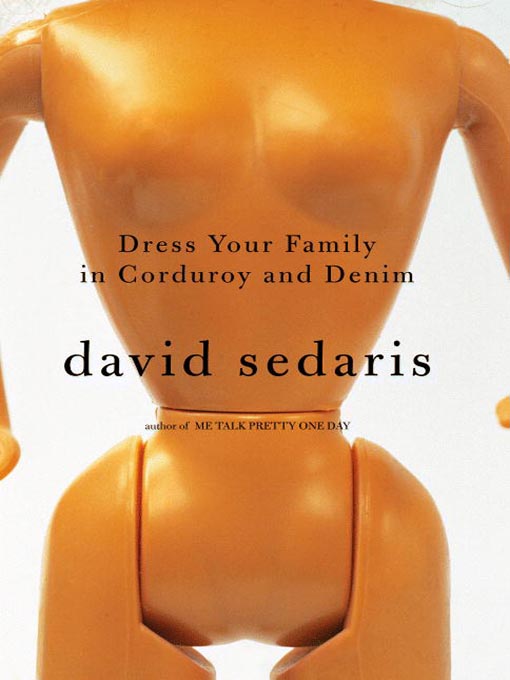
Dress Your Family in Corduroy and Denim - David Sedaris (Audio)


After having reviewed "Me Talk Pretty One Day" and "When You Are Engulfed in Flames", I'm not sure how much more I can say about Sedaris, his wit, and his narration skillz. Not everyone loves his brand of humor, but I do, and I will keep coming back for more as long as my library continues to carry his audios. (I am number two in line for "Squirrel Seeks Chipmunk", his latest.)

First of all, the best way - the ONLY way - to experience his humor is through audio. As the narrator, Sedaris delivers his schtick as it was originally intended...dry, slightly whiny, sarcastic, and self-deprecating. And interesting mix, but one that works.

He focuses primarily on various experiences with his quirky family in this installment. Not all the bits are funny. Some are poignant or sad, some just fall flat, but a majority of them make me giggle, and a few extracted big, ugly belly-laughs.

Of course, I want to tell you about the belly-laugh parts, but I know something will get lost in translation. Anyway. Sedaris tells us about the weirdos that lived next door to his family when he was young. In true form, they come trick-or-treating the DAY AFTER Halloween when the Sedaris candy bowl has been depleted. Mother Sedaris asks David to give them some of his candy stash, so he promptly goes to his room and starts stuffing the best goodies into his mouth, nearly choking, but determined to prevent it from falling into undeserving hands. I can almost envision the scene!

He also recalls a conversation he had with someone from the Netherlands about their version of Santa Claus, and begins to compare our folk tales with theirs. It is always fun to stand back and analyze the nonsensical nature of the stories in literal translation:

"A Dutch parent has a decidedly hairier story to relate, telling his children, 'Listen, you might want to pack a few of your things together before going to bed. The former bishop of Turkey will be coming tonight along with six to eight black men. They might put some candy in your shoes, they might stuff you into a sack and take you to Spain, or they might just pretend to kick you. We don't know for sure, but we want you to be prepared.'"

I find Sedaris endearing. He can be a real horse's ass sometimes (and I'm sure his family finds his use of "material" infuriating), and other times oddly vulnerable. His admission of drug addiction, his struggle to come out of the closet and his family's struggle to accept, his obsessive/compulsive urges (like the need to touch people's heads), and his innocence in trying, but failing, to help a disturbed neighbor girl...it all speaks to his humanity.

I don't think this is his best collection, but I still enjoyed it. Or am I just getting used to his style? The stories do seem to all blend together from book to book. My biggest issue at this point is convincing our library to carry some of his other works on audio, because I refuse to read them in print!

3.5 out of 5 stars


Friday, November 19, 2010

White Cat - Holly Black (Audio)


After the kids and I finished Mockingjay, I was looking for something to listen to in the car for the three of us. White Cat was well-reviewed by Beth Fish Reads, it was written by Holly Black of the Spiderwick Chronicles, and who could resist that cover? So sultry with all that black leather against that beautiful feline. And, after all, I sort of feel like I am the White Cat blog, with Casper the freak-show as my mascot.

Synopsis: Cassel Sharpe is the only "non-gifted" member of a family of curse-workers...a motley crew of folks that can alter memory, manipulate emotions, and even kill with their powers. Cassel desperately wants to fit in with his private school classmates, and does a decent job by being a pretty good con artist and dorm bookie, but is haunted by vague memories of killing his best friend Lila several years ago. He keeps his secrets to himself.

When Cassel wakes up on the roof of a school building, presumably from sleep-walking, things really start to get strange. Something is fishy with his brothers. Have they been performing memory curses? Why is his sister-in-law acting addled? Why does he keep having these strange dreams about Lila, posing as a white cat, telling him that he is the only one who can break the curse? He is also nervous and suspicious about his family's connection with the organized crime syndicate, who use illegal curse working for monetary gain.

My thoughts: I found the whole premise of this first installment of The Curse Workers Trilogy (of course it's a trilogy) very creative. Instead of drugs being the driving force behind organized crime, it is curse work, because it is dangerous and illegal. Black does a respectable job of developing this alternative world of mind games and manipulation and the struggle for power.

I became very fond of Cassel. His character was a complicated maze of teenage hormones, faltering self-esteem and cockiness. His geeky-cool school friends reminded me of something from Napoleon Dynamite, and I look forward to hanging with them a little more. There were many other characters, though, that were shallow and two-dimensional - Cassel's grandfather, his brothers and Lila. There were hints of interesting history beneath the surface, just there to excite me, but it was kept at arm's length. Perhaps Black is saving something for installments 2 and 3?

To Black's credit, she didn't leave us in the middle of a cliff-hanger, which I think is a cheap tactic to get us back for the second installment (titled "Red Glove, which she is still writing). I'd be happy to come back without any of that strong-arming. My son and I really enjoyed the story...it didn't blow us away but we were entertained. My daughter stopped listening somewhere in the middle. She thought it was "weird and confusing", her words.

My daughter is right, the plot is a bit twisted. There were a few times when I wasn't sure what was going on, but just allowed myself to go with the flow. There was some language - nothing too shocking though. There was also some kissing and one close situation, but no sex or reference to sex. I felt comfortable with my 11 year old listening.

A few words about the audio production: This audio was narrated by actor Jesse Eisenberg, who is probably most known for his leading role in "The Social Network". Even though he is in his late twenties, he has a very young-sounding voice and lent itself to the spirit of Cassel's personality. He talked a little too fast, and did not use much inflection, which could be his style, or could be inexperience in narration. But after a disc or two, we got used to it.

Me: 3.5 out of 5 stars
My son: 4 out of 5 stars
My daughter: 2 out of 5 stars

Thursday, November 18, 2010

Backseat Saints - Joshilyn Jackson (Audio)


First there was Gods in Alabama, a novel that I believe has the best opening line EVER. A true example of Southern fiction at its finest, with all the trimmings. Cussin', shootin', drinkin', fightin' and lots of childhood dysfunction and humor to cover up the tears. Born from this story was the minor character of Rose Mae Lolly, an ethereal, mysterious girl with a violent past. Jackson is back again to tell the story of Rose Mae.

Synopsis: Rose Mae thought she was starting a new life when she ran away from Fruiton Alabama, where she was abandoned by her mother and beaten to a pulp by her angry, alcoholic father. Unfortunately, Rose Mae is one of those women who attracts violence, and marries an abusive husband. After years of trips to the ER, Rose Mae is warned by a gypsy that she must act now or she will end up in the morgue. So Rose Mae grabs her fat, three-legged dog, her granddaddy's gun, and runs like hell.

Rose Mae first stops in Fruiton, to find her old boyfriend Jim Beverly, who disappeared her senior year in high school (if you read Gods in Alabama, you know how that turns out). She also confronts her withered father, trying to find closure from all those healed bruises. From there she embarks on a journey to find her mother in California, hoping to also escape a husband she knows is going to try to hunt her down and kill her.

My thoughts: I would read Joshilyn Jackson any day, anywhere, anytime, on a train, on a plane, with a fox, in a box. On the surface, she might qualify as women's fiction, or southern fiction, but there is really alot more going on here. In this particular story, I went through a variety of emotions as Rose Mae traveled on her journey of self-discovery. Pity at her battered life. Confusion at the internal battle between the persona of Ro Grandee and Rose Mae Lolly, then when she assumed the completely new identity of Ivey Rose. Does she even have all her marbles? Would I blame her if she didn't? Is she delusional to take off across the country to find a mother she hasn't seen since she was 8?

The important thing to note with Jackson is that even though her stories contain plots that have been run into the ground, everything you read feels fresh and new. Plus she is funny HELL. Laughing at one's misadventures in life is the southern way, after all.

If I were to compare this book with Gods in Alabama, though, I would have to vote for Gods. It seemed to have better flow. Backseat Saints seemed a little fragmented, with sharp turns in the plot that left threads hanging. The resolution of the story was predictable as well, but aren't all domestic abuse cases? These are minor complaints, though, and didn't diminish the fun ride.

A few words about the audio production: Unlike Gods in Alabama, this book was narrated by Jackson herself. Normally, this is not a good idea. There are professionals out there that do these things for a living. But with Jackson? If she ever decided to quit writing (praise the Lord, no!) she could always fall back on audiobook narration to pay her bills. She is delightful. Her tiny, melodic little southern voice personified Rose Mae. I hope she decides to narrate all of her books in the future.

4 out of 5 stars


Friday, November 12, 2010

My thoughts on Mockingjay (Audio) - NO SPOILERS


If you meander about the blogosphere, you know that there isn't much I can say about Mockingjay that hasn't already been said. Third and final installment of The Hunger Games series. Some people loved it. Some hated it. And some were just apathetic. I don't intend to spoil the plot, so if you haven't read it, please don't be scared. I'm just going to chit chat a little.

The kids and I listened to all three books on audio. With Mockingjay, by the time I remembered to get in line for it at the library, I was close to number 50. This would never do, so I actually bought it from Amazon. There was much excitement in the Nawrot household when it arrived.

I refused to get bogged down by all the opinions out there. I went into it with an open mind.

And I was sorely disappointed. Katniss seemed to have lost her spunk and vitality. She had been through alot of trauma in the first two books, so that is understandable, but her ability to pick herself up by her bootstraps and fight the good fight was what we loved about her. She seemed to be perpetually uncertain and high on pain-killers. The plot drug on, and on, and on. I was so bored I could cry. Oh sure, there was a body count, but it felt forced.

The last third of the book, the pace did pick up. We saw a glimpse of the Katniss we all knew and loved. Then she retreated again. We were halfway through the last disc, and I wasn't seeing a viable ending. Then, Collins hastily wrapped it up with a big fat bow, threw it at us, and ran. I passed it off to my BFF, wished her luck, and moved on. *grumble, grumble*

The audio was 10 discs long, and it took the kids and I a good solid month, maybe even slightly more, to get through it all. So while the kids would tell you they were "OK" with the story, they weren't begging to listen every time we got in the car. There were times when they even forcefully told me to turn it off.

All that being said, if you have invested in the trilogy, then you have to finish it. Just don't get your hopes up.

If you want to see the book summarized in the most brilliant way imaginable, please go visit my blogging buddy Jennifer @ Literate Housewife, who chose to write her review in Haiku form.

2 out of 5 stars

Thursday, November 11, 2010

Red Hook Road - Ayelet Waldman (Audio)


When you reflect back on your life, there are certain events that you never forget. Births, weddings and deaths are among these. Beginnings and endings. The idea of death intruding on the sparkling optimism of a wedding isn't something I even want to allow myself imagine, so it was with trepidation that I listened to this audio. I went into it knowing there would be pain. Others who have read the book made assurances that hope outweighed grief, but I was skeptical.

Synopsis: Two families, one wealthy and one blue collar, one local and one From Away, come together on a cloudless Maine summer day to celebrate the wedding of John and Becca. Gossiping attendees, irritated relatives, a controlling mother of the bride, the father of the bride that brings two left dress shoes, a flower girl that forgets to throw the rose petals...predictable havoc. Only this day ends in tragedy...the bride and groom are killed in a car accident on the way to the reception.

The two families, neither whom like each other very much, and couldn't be more different, must struggle through their grief together and bury their children, the services held in the same church still bearing remnants of the wedding from days prior. Conflicts arise immediately, stemming from differences in religion, expenses and affordability, family plots, both sides playing the blame game and wrestling for the upper hand in a no-win situation.

Each summer, we revisit the families and get a glimpse of their grieving and healing. The battle of the mothers. The inability to get past the tragedy. The depression. The failing of a marriage. But there are shards of promise as well. A romance blossoms between John and Becca's siblings. Becca's grandfather, a professional`violinist and Holocaust survivor, finds a musical prodigy in John's niece and begins to tutor her. The two families begin to find common ground. The two families begin to move on.

My thoughts: I think that was a pathetic excuse for a synopsis. But I'm having trouble finding the right words to express the beauty and complexity of this story. Right out of the gate I'm going to tell you that this story is heart-breaking. I didn’t know John and Becca at the beginning of the story, so I felt sorrow at a distance. I was left amongst the survivors, who, as they went through the grieving process, reveal their memories of John and Becca as babies and toddlers, their antics, their personalities, how they met, their courtship, their dreams for the future. I felt the raw pain of the mothers, the fathers, the sister and brother, and I began to really hurt for their loss.

Then it became a complicated character study. John’s hard-working, no-nonsense mother Jane who resents the wealthy outsiders that invade her peaceful hometown. Becca’s father, Daniel, who turns to his old profession of boxing to get him through his darkest days. Iris, Becca’s headstrong mother, who painfully admits to herself that she always preferred her older daughter. Becca’s little sister Ruthie, a quiet, inward young woman who has only lived to please her mother. These fragile personalities struggle to make sense of John and Becca’s death, and try to move on with their lives while stumbling around blind and making serious mistakes along the way. Not all of them are likable, but are so very three-dimensional and resemble real people in all of our lives.

The colorful cast of characters isn’t the only thing competing for your attention and your heart in this story. Also playing a leading role is the small coastal town of Red Hook, Maine. The fresh lobsters, the local beer joint, the slow pace, and the community’s passion for sailing are things that you can almost smell and hear and taste as the words float by your eyes (or ears!).

All of this made an impact on me. I grieved with these folks, and slowly allowed myself to smile here and there as they found small pieces of joy. But what left me speechless and brought my thoughts back to the book for weeks after I finished, was the Coda. After becoming a part of the family, after developing a love for John and Becca through their relatives, Waldman takes us back to the last thirty minutes of their lives. The segment was almost dream-like; ghosts dancing on the beach, kissing and high on life. I had to go back and listen to it several times. It was masterful.

A few words about the audio production: Red Hook Road was narrated by Kimberly Farr, who is a veteran narrator (The 19th Wife, My Name is Mary Sutter, American Wife, My Life in France). She is pleasant to listen to and did a great job with various accents, including those wonderful Maine drawls. At just over 14 hours, this was neither too long nor too short…just right!

4.5 out of 5 stars


Tuesday, November 9, 2010

Last Night in Twisted River - John Irving (Audio)


Somewhere in the back of my mind, I think I recall that John Irving may have been the original inspiration of Rebecca's term "pantyworthy". (Meaning the author is at such a rock-star status, that bibliophiles could be inspired to throw undergarments at them.) Whether this is true or not doesn't matter...it is what I think of when I hear the man's name. Yes, the man is attractive, and yes he is a storyteller. I was quite open to the idea of Irving's latest, Last Night in Twisted River, being our first official read for the Heathrow Literary Society. I needed to get in on the excitement.

Synopsis: Widower Dominic Baciagalupo, a cook for a small logging community in New Hampshire, and his son Daniel live a modest but comfortable existence until two tragic events change the course of the rest of their lives. Dominic decides that to best protect his son, they must flee, and do so for a majority of their lives.

Covering 40+ years and thousands of miles (including Boston, Iowa, Colorado and Canada), Irving delivers with vivid description the lives of Dominic and Daniel and their odyssey. The rugged logging lifestyle, the drug culture and Vietnam, the passion of en familia Italia in Boston, a street-level view of the restaurant business, the life of a successful author, child-rearing in an all-male single-parent household, US politics after 9/11, and probably a dozen more storylines I'm not remembering.

There is more here, though, than a slice of the 20th century pie. It is also about the softer stuff...manhood, friendship, loneliness, loyalty, pride, and love. Perhaps for Irving, this is his all-American novel?

My thoughts: This is one of those books that you must go along for the ride. To enjoy the ride, you're going to have to come to terms with total cohabitation with the Baciagalupos for as long as it takes you to read 574 pages (or 20 discs). There is alot of detail to wade through here.

Overall, I found the story mildly entertaining. Intriguing at times, slow at others. I thoroughly enjoyed shadowing Dominic in his life as a cook. His famous pizza, his pasta dishes, his dabbling in French and Chinese cuisine...I felt my inner foodie purring at the description of Dominic's creations. I would also presume most of you would find the development and nurturing of Daniel's career as a successful novelist to be of interest as well. The writing process, the joy and angst of having books adapted into movies, and the incorporation of an author's personal experiences into his books is something that obviously came directly from Irving's heart.

The character of Ketchum, Dominic and Daniel's life-long friend, confidant and protector, captured my heart. In fact, only towards the end did I realize that Ketchum was as much of a main protagonist as the Baciagalupos, and was the underlying soul to Irving's tale.

I had some numerous gripes as well, some minor and some major. Irving tended to repeat Dominic and Daniel's names, their full Christian names with all aliases, all the time. I wasn't sure what his point was, but it bothered me. There was also a significant amount of jumping back and forth in time, and back and forth between characters. This was extremely distracting until about 2/3 of the way through the book, when I began to notice that there was a pattern. The pattern having elements of teasing and a building of tension from time period to time period.

I also felt that the ending was contrived. I'm skirting around the details of this one because of spoilers, but Daniel's big moment at the end of the book, his big epiphany if you will, fell flat for me. It seemed that Irving reached into the grab bag of plotlines contained within the story, and plunked it down as The Answer To Happiness. I didn't buy it.

A word about the audio production: Funny thing about Arthur Morey, the narrator for Last Night in Twisted River. This is the second audio I've listened to with Morey at the microphone (first was Homer and Langely). With both books, I initially was bored with his voice...it just kind of echoed inside my brain and sounded like the teacher in Peanuts (wwwaaaah, wa wwwwah, wa wwwwah). But in both instances, he grew on me and ultimately was very comfortable with the listening experience. He's not my favorite narrator, but I'd happily listen to him again.

Thoughts from the Heathrow Literary Society: We had a most excellent discussion in our newly-formed book club. We have a wonderful mixture of old and young, chick-lit readers and some of the most well-read people I've ever met. The discussion was lively and insightful. Overall, nobody loved this book. For admirers of Irving (one man had read EVERYTHING Irving had written), this was not a good representative of Irving brilliance. It was noted that the elements present in Twisted River were the same elements that had been included in other Irving novels as well, and this was just a compilation. They had been there, done that. We all agreed the only reason this book would ever be read was because it had been written by Irving.

3 out of 5 stars


Friday, October 29, 2010

The City and the City - China Mieville (Audio)


I am a huge fan of the mystery thriller genre, but I would be the first person to admit that a vast majority of the plots out there are predictable and forgettable. I'm tired of the religious zealot/mother obsessed serial murderer that dismember/eat their victims/take souvenirs, I'm tired of the damaged protagonist's loved one getting kidnapped but living when everyone else dies, I'm even tired of the male and female protagonists that can't seem to cast aside their hangups and get together while chasing bad guys. Please, people, something original!!!!!

Ask and ye shall receive, says China Mieville.

Synopsis: On its surface, it is business as usual. Dogged investigator Tyador Borlu has been assigned to the murder of a young woman found in an empty lot in his home town of Beszel (vaguely Eastern European). Through the first person narrative, Borlu begins to suspect that this is not a straight-forward crime, but one that may have breached borders with Beszel's neighboring city Ul Qoma.

Borlu reveals a unique relationship between these two cities that exist amongst and betwixt each other. Beszel exists in the same physical location as Ul Qoma, but the inhabitants, their language, their dress, their architecture, their officials, their laws, EVERYTHING is separate. A passport must be used to travel from one city to the other. Political struggles abound. Citizens of either city are taught from an early age to "unsee" anything from the other side, and if they dare breach, a sinister KGB-ish group emerges from the mist to rain down all kinds of hell on them. So begins one of the most complicated cases of Borlu's career.

My thoughts: A little confused? Yeah, so was I for at least a disc or two of the book. The story lulls you into what seems like a typical police procedural, then it takes a 90 degree turn and you find yourself in very strange, unfamiliar territory. How did I get here? What on earth IS this? HELP!!!!! I've gotten lost before though, and my general response is to just relax and go along for the ride. In this case, it works itself out quite nicely. In fact, this was the equivalent of a 10K for the brain - it got those lazy cells humming. I marveled at the uniqueness, the cleverness of Mr. Mieville and figure he must be some kind of a genius. I know I am not alone in this sentiment. This book has been highly regarded in the book blogging community, justly.

So. Anyone out there want to see if some equally genius director make this into a movie? A show of hands?

A word about the audio production: Narrated by John Lee, he of the smooth and enticing British accent, and narrator of "Drood", "The Guernsey Literary and Potato Peel Pie Society", "World Without End" as well as other Mieville audios, is flawless. He can utter his words through my headphones anytime. He makes an audiobook experience what it is all about.

4.5 out of 5 stars

Friday, October 22, 2010

Ravens - George Dawes Green (Audio)

Probably about 6 months ago, I read a review on Ravens that inspired me to order the audiobook and load it onto my iPod. When I was recently browsing through my audio selections, looking for something that would work for the RIP Challenge, I saw this and had forgotten all about it. I had no clue what it was about, and for some reason thought it was YA (it is NOT by the way). I went into it blind, which is always kind of fun.

If I had to put this story in a category, it would be a psychological thriller, but is not your garden variety thriller by any means. Let me explain.

Synopsis: The Boatrights are just a notch above Georgia white trash. They are seriously strapped for cash, Momma is an alcoholic and plays the Lottery every week, Dad is a dried up holy roller, and their two kids are lost in the middle. Tara, their oldest college-age daughter, dreams of getting the hell out, and finds her only solace in her spunky Grandmother. Then one day, their dreams all come true - they win the $318 million jackpot.

Shaw and Romeo - old friends, toxic relationship, dead-end jobs - are heading to Florida for vacation when they learn about the jackpot winners at a local gas station. Shaw decides this is their chance to make it big, and holds the Boatwrights hostage by threatening their lives unless they share their winnings. The two young men immerse themselves in the small town, claiming to be long lost friends of the Boatwrights, claiming to be children of God, making emotional connections and inspiring awe and religious fervor. It is the ultimate con. Only one old, bumbling police officer doesn't buy the story, but can he rise above his nickname "Deputy Dawg" and do something about it?

While the con is occurring, strange emotional transformations begin to take place within the hearts of the players. Tara hates Shaw for what he is doing, so why does she get excited when she thinks about him? Romeo just wants to be a loyal friend to Shaw, but can he really kill these people if called upon to do so? Is Shaw really the sociopath that he seems to be? Is the $315 million a blessing or a curse? It all climaxes in a violent, unpredictable ending that leaves you feeling a little bit dizzy.

My thoughts: This is one complicated little yarn. Characterization in spades - these people are big and loud and flawed. Narration occurs throughout the book in a variety of voices, including Tara, her parents, Shaw, Romeo, the deputy, and other townspeople. This allows the reader to get down deep into the minds and psyche of some messed up folks. You begin to empathize with the bad guys, question the good guys, and multiple times I wondered where the heck this was all going, except south. As the story progresses, the pace accelerates, the heart beats faster, then BAM. It's over.

I was left with a very strange feeling in the pit of my stomach. Did I like it? I THINK so. I sure thought about it a long time. But the book presses your nose in alot of bitterness, greed, self-absorption, jealousy, fear...dark stuff. And despite a definitive end, I didn't get a sense there was going to be much sunshine in the lives of the affected for any time in the near future. As a reader, can you live with that?

A word about the audio production: Phenomenal. There was a female narrator assuming all of the female characters, as well as a male narrator for the men. The female, Maggi-Meg Reed (The Time Traveler's Wife, Prayers For Sale, Home), was deliciously southern and trashy. The male, Robert Petkoff (Beat the Reaper, Room, So Cold the River), was young and clipped and cold. Both are seasoned veterans in the audiobook world, and it showed.

4 out of 5 stars


Thursday, October 21, 2010

Homer & Langley - E.L. Doctorow (audio)


Have you ever watched shows on television about the hoarders? We don't watch alot of TV, but when the hoarders find their way onto one of the channels, it is physically impossible for me to turn it off. It is fascinating and horrifying all at once, and in a sick way it makes me feel good about the few measly piles of books in my bedroom.

I am certain this is why there has been so much morbid curiosity about Homer and Langley Collyer, who gained notoriety as two eccentric hoarding brothers who lived, and ultimately died, in their 5th Avenue brownstone apartment in the first half of the 20th century. Much has been written about the 50 years worth of newspapers, the Model T Ford, the numerous pianos, typewriters, televisions, irons, chandeliers and junk that was hauled out of their home, or how it took ten days to actually locate one dead brother under the detritus. But what of their lives? E. L. Doctorow gently reveals not only the brothers' descent into madness, but lives intertwined with the unfolding of the growth of our nation.

Synopsis: The colorful story of the Collyer brothers' lives is narrated by 62-year-old Homer, who has been blind since his teens and has recently gone deaf. In a pleasant, humorous voice he tells of his incredible history through his sightless impressions: Emotionally-distant parents that were struck down by the Spanish Flu. The younger Langley who fought in WWI and came home damaged and primed for what was to become four decades of an obsessive interest in junk. Their hosting of speakeasy-like tea dances during Prohibition. Their Japanese-American housekeepers who were hauled off to an internment camp upon the bombing of Pearl Harbor. Homer's infatuation with a piano student-turned-nun who is murdered on a mission in El Salvador. Their friendship with a mobster who uses their apartment as a hideout. The beatniks that "crash their pad" and share their pot and women. It is a charming microcosm of American history.

And while history is occurring, so is the Collyer's refusal to play by the rules. The telephone is the first to go, followed by electricity and water, after their failure to pay their bills. They board up their windows to ward off gawkers. They cook their meals with propane and haul in water from a spigot in Central Park. No way you could make this stuff up.

Boiled down though, after you get past the bizarre behavior and the history lesson, you are left with the loyalty, dedication and love between the brothers. Left with only his brother's touch to save him from loneliness and starvation, Homer endearingly forgives Langley of his foibles and just loves him for being.

My thoughts: I couldn't help but be reminded of my beloved Middlesex when listening to Homer and Langley's antics...an enchanting mixture of oddity and historical events, whimsy and gravity. Except this is the real deal. The prose may not be as beautiful as what Eugenides provides, but nothing can quite compete with pictures, can it?

I thoroughly enjoyed this story from beginning to end. Instead of portraying the reclusive brothers as societal rejects doomed to die in their own filth, Doctorow depicts them as sympathetic, full of wonder and living large. Is this an accurate reflection of the men behind the boarded-up windows and dead-bolted doors? I'd like to think so. After all, Doctorow does have Homer's diary as evidence of their humanity. I like to believe that everyone has a story, and everyone is inherently good.

A word about the audio production: Our narrator for this audiobook is Arthur Morey, who has had extensive experience in the field. (He is the narrator for Last Night in Twisted River by John Irving, which I just uploaded on my iPod). Initially, he seemed just average...he sounded alot like the guy that introduces the title and plot of many of the audios (who knows, maybe he is). But I began to appreciate his gentle, grandfatherly voice and various vocal inflections, and by the end of the book, he embodied Homer.

4.5 out of 5 stars


Friday, October 15, 2010

America - Jon Stewart (Audio)


Admission: I don't watch The Daily Show. In fact, I rarely watch television at all. But I do know Jon Stewart is a funny funny man. I'm not that out of touch.

But when Kathy (Bermudaonion) tells me I have to listen to an audio book so I can laugh my head off but warns me I might be offended, I don't have the will to resist. After all, the audio only takes a few hours to complete, so what do I have to lose? (Apparently just my dignity at almost wetting my pants.)

The book is structured as a mock textbook about US History. It has discussion questions at the end of each chapter. Classroom activities. Supplemental material. And with rude language and politically incorrect brattiness, it unleashes its wrath on everyone, from our esteemed forefathers to the Bush Administration. It is like the ultimate roast, and nobody can hide.

A few quotes:

The Enlightenment: Oppression and high mortality rates seemed ready to swallow what remained of mankind, when through the darkness emerged the light that would be its salvation: Reason. It began slowly. "Hey, what if we stop storing the corpses in the drinking water and see if that makes any difference to our health?"

If the presidency is the head of the American body politic, Congress is its gastrointestinal tract. Its vast and convoluted inner workings may be mysterious and unpleasant, but in the end they excrete a great deal of material whose successful passage is crucial to our nation's survival.


Hmmm...somehow, that just feels inadequate. Suffice it to say there are hundreds of quotable quotes, coming at you like rapid gunfire from all directions. At one point, through my tears I laughed and said out loud, "I can't take it anymore! My stomach hurts!!!". I even had a particularly blood-pressure-raising experience with Walgreens (as occurs almost on a weekly basis) and this audio eased me back into a state of healthful happiness.

The audio is narrated by the cast of The Daily Show, and all do a fine job as our "educators". There are a few audio effects that add to the overall experience...the ringing of a bell between discussion questions and buzzers to indicate our thinking time is up. It was all quite clever.

If you are looking for a little time-off from some of your more serious reads, allow yourself three hours of fun with this. Just remember to listen with your dander down, and without the kids in earshot!

4 out of 5 stars


Friday, October 8, 2010

The Immortal Life of Henrietta Lacks - Rebecca Skloot (Audio)


What do you first think of when someone says "Non-Fiction"? Self-help? A boring history lesson of the French Revolution? Bad celebrity memoirs? I think sometimes the reputation of non-fiction precedes itself, for whatever reason, and is excluded from potential reading lists.

If someone told me I could only read non-fiction for the rest of my life, I'd be OK. Let's just take a look at some of non-fiction I've read lately: Columbine, A Hundred Feet Over Hell, The Glass Castle, The Girls from Ames, The Monster of Florence. Give me true stories, give me pictures, give me something I can use! Up there with the best of the best, though, is Henrietta. I was thrilled that our book club chose this as our September selection. Behold one of the most incredible stories you will hear this year.

Synopsis: Henrietta Lacks was a poor, unschooled African-American woman who, in 1951, was diagnosed with an aggressive cervical cancer at the age of 31. Eight months later she died, leaving behind five children (the youngest just a baby) and a husband. Before her death, the doctors at Johns Hopkins Hospital took a biopsy from her cervix to study her cells. Where most cells died quickly after collection, Henrietta's cells were hearty and multiplied rapidly. This was a dream come true for researchers, and soon Henrietta's cells (called HeLa) were in the hands of scientists around the world, being used for testing to cure polio, cancer, aids, even acne. HeLa revolutionized modern medicine.

As a young science reporter, Rebecca Skloot was fascinated with the story of HeLa and began researching its history, and the history of Henrietta, in order to write a book. What she discovered was a family plagued with tragedy, poverty, abuse, drug addictions and murder. The family was hounded by fortune seekers looking to profit from Henrietta's legacy, and distrusted anyone and everyone. The family couldn't even afford health care, and Henrietta's grave was still unmarked - a shocking contract from the billions of dollars made from HeLa.

Skloot eventually forged a bond with Henrietta's youngest daughter Deborah, and the two of them launched on a journey to learn everything they could about Henrietta's immortal cells and the impact her contribution made on our world today.

My thoughts: It seems counter-intuitive that a topic such as this could be the least bit readable. However, Skloot does an excellent job of boiling down an enormous amount of scientific information in a simple, palatable story. I was never lost or confused...it all made perfect sense. I was impressed that she presented the facts in a professional, unbiased voice (and still my blood was boiling...hers had to be as well). She asks some extremely difficult, ethical questions as well, pertaining to rights of tissue donors. Ones I don't think I am capable of answering. Still I am left with this outrage! How could the family of a woman who gave the world HeLa not even have health insurance????

On a more human level, Skloot's research into HeLa becomes just as much a memoir of her journey with Deborah and the Lacks family. My official, non-spoiler statement to you is that it is beyond heart-breaking. Have your Kleenex ready. It will rip your heart out.

The audio production: As soon as the narrator's voice started speaking, I knew instantly who it was. Cassandra Campbell, the narrator of the much-loved "The School of Essential Ingredients". Her voice is smooth and silky, emotional and real. You will never be disappointed with one of her performances.

The book club (now named Books, Babes and Bordeaux) weighs in: Picture if you will seven women sitting at a round table, all chattering loudly and excitedly above the restaurant music, all at once. That is what the discussion was like all night long. We all had so much we had to expel from our hearts that we couldn't talk fast enough. It was obvious that our buttons had been pushed by Henrietta. It was universally loved and it universally broke our hearts. None of us could answer the ethical questions posed by Skloot, but at the end of the day, it was hard to swallow the Lacks' financial hardship while Henrietta's cells were generating millions of dollars. Overall, this was an excellent choice for animated book club discussion.


5 out of 5 stars


Thursday, October 7, 2010

Faithful Place - Tana French (Audio)


There are only a few things in life you can take for granted. Death, taxes, the sublime beauty of red wine, and great Tana French novels. At this point, I am asking myself if I would be capable of writing a negative review for Ms. French's work. I don't think so. I have fallen under her spell, so consider yourself warned.

French has an interesting way of structuring her "series". In her first novel "In the Woods", the story is narrated by Rob Ryan, a police detective, with his partner Cassie Maddox playing a strong supporting role. In French's second novel "The Likeness", Cassie is at the center of the action. In "Faithful Place", French's latest, the story revolves around Frank Mackey, Cassie's toughened boss in undercover. Funny, Frank never even really registered on my radar in "The Likeness", so I wasn't all that intrigued by a story about him. Reviews were mixed. I proceeded with caution. Like I had anything to worry about. Mind the drool puddles and you meander through my review.

Synopsis:

Frank Mackey has had a rough life, living on the wrong side of the tracks in a blue collar neighborhood in Dublin. He and his four siblings grew up quickly and harshly under the roof of an angry mother and an abusive and alcoholic father, and all dreamed of "getting out". When Frank was 18, he had made plans to run away to London with his high school sweetheart Rosie, but when she failed to show up for their late-night rendezvous, Frank left and never came back. Although he assumed he had been dumped, he never heard what had become of Rosie, her absence overshadowing every facet of his life ever since.

His past comes 'a-calling twenty years later when Rosie's suitcase, filled with her clothes and two train tickets to London, is found hidden in an abandoned apartment in his old neighborhood. He gets sucked back into the mess of his family's dysfunctional mind games, and memories of a his first love and carefree youth when anything was possible. But this isn't just a stroll down memory lane...the underlying darkness present twenty years ago is alive and well today, and reawakens to finish an unsettled score.

My thoughts: I almost hated to use the words "dysfunctional" and "family" in this review, because I am sick to death of reading about it. Nothing, however, is ever passe in the hands of Tana French. She takes a mystery/thriller and makes it fresh and different. She has a keen gift of characterization that is so intense, that her people become your people, and suddenly that age-old, tired family crap feels very very personal.

I like to think of French's stories as having an undertow. You are just out there splashing around, unaware of the turbulence and danger present underwater. Before you know it, it has dragged you under and you never know what hit you. "Faithful Place" is very similar to her first two books in that there is alot of childhood baggage and reflection on buried issues, occurring at the same time as present-day trouble. Thereby creating a mystery thriller with a significant edge over the competition. The emotions and relationships are complex, and sometimes are not resolved by the end of the story. I give French credit for fighting the urge to fall into line with the unmemorable mystery thriller masses.

Frank Mackey was an interesting protagonist. Feisty, a little bit of a rebel, angry, holds a grudge, and far from perfect, he is also wears his emotions on his sleeve and wants to be a better person. I found his efforts at being a good father and protecting his daughter very sweet and kind of attractive. I really liked him (REALLY) despite all his frailties. It could be considered a little bit of a crush. And even though I know how French structures her series, I cast a gooey-eyed glance toward the future and hope I see Frank again.

The mystery was not all that difficult to figure out, and this is probably the biggest flaw in the story. But maybe that wasn't the point. This story was more about damaged youth, with the inevitable "reveal" being more heart-breaking than shocking. This was my least favorite of French's three novels, but please know that I am still very deep in the "love" range of the spectrum.

About the audio production: Simon Vance, someone is threatening your spot on the narrator pedestal, and that is Tim Gerard Reynolds. It does not appear that Tim has had much experience with audiobook narration, but I pray that is going to change. That Irish accent, his effortless emotion...it seemed like French's words were his own. I could have listened to him forever.

4.5 out of 5 stars


Tuesday, October 5, 2010

A Reliable Wife - Robert Goolrick (Audio)


Liars and perverts and murderers, oh my! It has been weeks since I finished this audio, and I still have a slightly foul taste in my mouth. The reviews had run the gamut, from adoration to disgust, and everything in between. It still didn't quite prepare me for the sludge that I would have to wade through to finish this book.

So, in a brief nutshell, without blowing any of the nuggets of surprise, here is the plot. The setting is turn-of-the-century rural Wisconsin. Catherine Land, of questionable background, responds to an ad from a wealthy businessman (Ralph Truit) looking for "a reliable wife" with which to form an arranged marriage. Both parties have ulterior motives; we find this out early. We just aren't sure exactly what they are, and to what lengths each will go to in the fulfillment of their goals. What we DO know is that Catherine is worldly but pretending to be innocent, and Ralph is a sex-obsessed pervert as a result of a religious-fanatic mother. Good times.

Thus begins the peeling of the layers, and the winding path of twists and turns. My heart raced and I became excited...perhaps there is hope! I began to compare the various twists and reveals to Fingersmith and was intrigued. That was short-lived, however. I won't bother you with details, but with the progression of every disc, the characters become even more pathetic, despicable and obnoxious. By the end of the story, I threw up my hands in disgust and declared that they all deserved each other.

St. Louis and Chicago in 1907 is fascinating stuff. Goolrick created a rich, gothic feel to these cities that were both hopeful and bustling, but also nurtured a foul, filthy underbelly of disease, corruption and prostitution. He created the cold, bleak hopelessness of rural Wisconsin in the winter. As a reader, you are transported.

As I stated before, however, the characters didn't win me over. Neither did the prose. There were scenes that reminded me of a cheap, tawdry romance novel, scenes that were laughable, and ones that made me want to just stop reading:


"Every exchange making him feel like an idiot, making him draw his spine up straight and making him fiddle with his hair, and all he wanted to do was to see her naked on the floor. Not brutal, not unkind, enraptured."


Or this:


The woman he wanted to undress, to see naked, was a stranger. Her conversation, her requests, were strange to him. Nobody had asked anything of him for so long. "I'm not....I'm not pure. You should know." He watched her in silence. "I was a child. A friend of my father's, a fellow missionary in Africa. He came to me one night and....I'm not pure. Not without the sin of fornication. My father killed him. You should know." Mercy touched at his heart. He held her hand, just for a moment, for the first time. "That life is past. It was a long time ago. It was not your fault. Don't think about it anymore." She looked so far away. "It doesn't matter to me. Nobody's pure. My daughter, my Francesca was pure, but nobody else."


Aye, Mother Mary, deliver me from this story.

Now about the audio production. Our narrator, Mark Feuerstein, was a bit dry, with not much range between male and female voices, or much inflection. It wasn't necessarily distracting, but not engaging either. I don't think I would seek him out for future books.

As I re-read through my review, it seems like all bad news. Many of my blogger friends didn't agree. They loved it, calling it "perfect" and "page-turning", including Julie @ Booking Mama, Rebecca @ The Book Lady's Blog, Swapna @ S. Krishna's Books, Jen @ Devourer of Books, Jennifer @ The Literate Housewife, and 90% of the book blogging universe. Just call me Mary Contrary.

2.5 out of 5 stars


Thursday, September 23, 2010

Major Pettigrew's Last Stand - Helen Simonson (Audio)


Major Pettigrew is a 68 year-old widower living in a small village in England who just lost his younger brother to an unexpected demise, making him take stock in his life. He is a proper, distinguished man who is set in his ways, loves his routine golf game, and is just a tad bit lonely. He finds himself attracted to the 58 year-old widow Mrs. Ali, a Pakistani woman who runs the local shop. In the past, he may have restrained from a relationship not deemed "proper" by the townsfolk because of Mrs. Ali's social status and the color of her skin, but the Major is beginning to see the merit of seizing the day.

The trouble is that the Major is surrounded by the prejudiced, judgemental, greedy, self-absorbed, materialistic members of his community. Ones that whisper behind his back about his relationship with Mrs. Ali. Ones that thrive on waving around the prestige of a country club membership, or an annual gala. His family isn't any better. His adult son is a spoiled, immature brat, and his brother's widow just wants to get her hands on the family guns to sell to the highest bidder. Throughout the story, one has to wonder when the mild-mannered Major is going to blow.

It is refreshing to read a story about finding love in the golden years of life, all the while gently nudging the conscience about issues of religion, class and race and the hypocrisy in a small town. The message could have come across as preachy, but instead was subtle and sweet, with a dose of endearing British wit. As a result, just about every review I've read has showered love and kisses on the book.

My experience was not so grand. For some reason, while I recognized the dearness of the story, I wanted to cry from boredom. The narrator, Peter Altschuler, had a wonderful voice with a lilting British accent. So it really wasn't his problem. Perhaps there wasn't enough action, maybe too much dialogue, or I was distracted, but I was PRAYING for it all to end. Would it translate better in print? Maybe, although Jen loved the audio. Chalk it up to misaligned moons I suppose.

2.5 out of 5 stars


Tuesday, September 21, 2010

The Prince of Mist - Carlos Ruiz Zafon (Audio)


Recently, I loaned my review of "Shadow of the Wind" by Carlos Ruiz Zafon to Trisha at Eclectic/Eccentric as a filler while she was on vacation. I giggled when she titled the post "Carlos and Sandy Sitting in a Tree". Well, yeah, who wouldn't want to sit in a tree and kiss the man who birthed the Cemetery of Forgotten Books, the evil Fumero, creates tangible atmosphere at the wave of his pen, and who writes and performs the music on his audio books?

So in keeping with my love affair with Zafon, my heart went pitter-pat when I saw that he was launching a new YA book called The Prince of Mist early this summer. I got it on audio, squeaked a little bit more when I saw the narrator was the dreamy Jonathan Davis (narrator for Shadow of the Wind) and decided it would be a good story to listen to with the kids.

The premise has Zafon written all over it. A boy on the edge of adulthood, Max, moves to the seaside with his family to escape the effects of WWII. He and his older sister Alicia befriend a local boy, and the three of them dip their toe into adulthood while exploring decades-old secrets that surround the town. A clock that moves backwards. A cat with a bad attitude. An overgrown garden full of menacing statues that seem to move when you turn your head. A lighthouse. A sunken ship. And a legend of a sinister character by the name of Doctor Cain who appears in the form of a demented clown, and makes deals that you can't refuse but come at a high price.


Yeah, right? I can almost hear what you are thinking. I think Zafon had his checklist of all spooky things in life EVER, and with this story, crossed them all off in the process of writing it. This story should have worked, but to an adult listener, it just didn't. To me, it seemed like a caricature, like a scary story I would make up off-the-cuff around the campfire to creep out my kids. It seemed contrived.

The plot also seemed very underdeveloped. I know it is Young Adult, but that is no excuse in my mind. There were traces of the writer that created Shadow of the Wind and The Angel's Game, but I was left wishing there had been more substance. Only after we'd finished the audio did I find out that this was actually Zafon's FIRST novel, and has been re-released by a new publisher. Obviously Zafon's writing has come a long way.

A word about the audio production. I have mentioned before that Jonathan Davis is a fine narrator, and he was up to par with The Prince of Mist. He displayed none of his acumen at accents, but he was still very easy on the ears. The audio had an enormous amount of sound effects...the crashing sea, a film projector, eerie music. There were sounds accompanying the narration at least half the time, maybe more. I found this to be distracting. The kids LOVED it.

In fact, the kids loved everything about this book. They would probably be very upset if they read this review. The story does contain some kissing, and someone does die, but at 10 and 12, my kids didn't find anything disturbing. Just deliciously spooky. There seems to be a small opening for a sequel at the end. The kids and I agreed this story would be better left alone.

My rating: 3 out of 5
My kids' rating: 4.5 out of 5


Thursday, September 16, 2010

Jenners and Sandy cook up a great American novel


Hello and welcome to the "Cooking the Books" show, where you, too, can learn to create amazing literary works of art! Today, your hosts Jenners and Sandy will be demonstrating their culinary prowess by preparing a most complicated dish, but one well worth the effort, and is sure to impress your friends.


Recipe for Middlesex by Jeffrey Eugenides

1 cup of Greece
2 cups of Detroit
1/2 cup of San Francisco
1/4 cup of Berlin

Mix thoroughly in a bowl and set aside.

Obtain a new copy of Flowers in the Attic by V.C. Andrews. Carefully remove the evil grandmother and spooky old house and delicately extract the incest story line. Place the story line on a greased 13x9 baking pan.


In a food processor, grind one U.S. history textbook, one genetics textbooks, and The Greek-Turkish War by Stravos T. Stravidis into fine powder. Sprinkle over the incest story line removed from Flowers in Attic.

Using a mandolin, slice the chrome from vintage Cadillacs into small cubes and mix with the hair of Howard Stern and three silkworms. Drizzle with the sweat gathered from the locker room of a girl's boarding school and the tears of immigrants. Then blend in a dollop of your choice (depending on your tastes) of tragedies of the ancient Greeks and 3 ounces of moonshine delivered by rum runners during the Prohibition. Fold gently into the bowl containing Greece, Detroit, San Francisco and Berlin.


Let the bowl sit for three generations. It will rise into a dough that has the scent of crocuses and the glimmering fish scales of a mermaid. Roll out the dough on a floured work surface and place the textbook-covered incest story line into the center of the dough. Roll the dough into an architectural shape that is pleasing to the eye but unfit for everyday life.


Melt the family scenes from My Big Fat Greek Wedding and brush onto the outside of the dough.


Bake for for as long as it takes you to listen to "Dude Looks Like A Lady" by Aerosmith, "The Immigrant Song" by Led Zeppelin, and "Pink Cadillac" by Aretha Franklin or until golden brown. Garnish with a Pulitzer Prize.


Yields: 544 pages or 17 discs of pure literary delight!


Notes from Chef Jenners: This wasn't my first recipe by Eugenides; I sampled his Virgin Suicides Family Platter a few years ago and found it not to be to my taste. But this recipe!!!! Mamma Mia ... what a wonderful glorious meal it is. Never before have I tasted a Prefetal Omniscient Narrator ... such a delight! And the Let's Progress Time Through A Series of Snapshot Phrases was succulent and tender. I'll definitely be sampling more of what Eugenides cooks up for us to enjoy. Bon Appétit!


Notes from Chef Sandy: If you would like to prepare the audio version of this recipe, you mustn't be intimidated. Simply add a new pair of tennis shoes, an MP3 player, and the voice of Kristoffer Tabori (who I believe was put on this earth solely for the purpose of this recipe variation) to the initial Greece/Detroit/San Francisco/Berlin mixture and blend well. Serve with a bottle of vintage 2003 Audie Award. Enjoy!